

Demand Anchoring: From Brand DNA to Spatial Scenarios
The first step in procurement is "looking inward", clarifying the positioning and target audience profile of the hotel suite.
• Style and tone matching: Furniture acts as the "translator" of the space style. If the hotel is positioned as a modern business suite, it should choose a minimalist design with clean lines and restrained colors; if it is a vacation suite, it needs to incorporate natural materials (such as rattan, wood) and gentle curves; if it is a cultural-themed hotel, the furniture itself should have narrative elements, such as mortise and tenon structure tea tables and carved screens in the new Chinese-style suites.
• Functional area segmentation: Suites usually include sleeping areas, work areas, leisure areas and bathroom areas. Furniture needs to be configured according to the needs of the target audience: Business guests need ergonomic office chairs, desks with USB/Type-C interfaces and sufficient luggage racks; family guests need to consider modular beds, rounded corner anti-collision designs and child-friendly storage spaces.
• Size and circulation planning: Suite spaces are usually large, but the scale of the furniture needs to be coordinated with the space ratio. A too-large sofa will compress the activity area, while a too-small bedside table will seem cramped. Before procurement, it is necessary to combine the interior design drawings and precisely plan the furniture size to the millimeter level to ensure that the door opening, curtain pulling, and luggage box unfolding and other circulation lines are not obstructed.

Supplier selection: From "price-oriented" to "value assessment"
The hotel furniture market in 2026 has shifted from "competing on price" to "competing on the full lifecycle value". When selecting suppliers, a multi-dimensional assessment model needs to be established:
• Hard power assessment: Focus on verifying the factory's production equipment (such as CNC cutting machines, environmental-friendly painting lines), raw material inventory (whether the moisture content of solid wood is controlled within 8%-12%), and quality inspection system (whether there are third-party testing reports with CMA/CNAS certifications). It is recommended to visit the factory in person to observe the standardization of the production process and the details of the semi-finished product area (such as whether the edge sealing is smooth, whether the mortise and tenon joints are tight).
• Soft power verification: Require suppliers to provide cases of similar hotel projects completed in the past two years and conduct on-site experience of the furniture's wear and tear (such as the rebound rate of sofa cushions, the scratch resistance of the desktop paint surface, the smoothness of the hardware). At the same time, evaluate their deep design capabilities - whether they can provide production drawings that can be implemented based on the rendering, and whether they can provide solutions for special structures in suites (such as irregular walls, hidden storage spaces).
• Environmental and safety bottom line: In 2026, the country has stricter requirements for the environmental protection of interior decoration materials. Suppliers must provide environmental testing reports for boards, paints, and adhesives to ensure that the formaldehyde emission is ≤ 0.025mg/m³ (ENF grade) and the flame retardancy meets the GB 17927-2011 standard. For soft furniture in suites (sofas, bedside tables), it is necessary to pay extra attention to the wear resistance times of the fabric (recommend ≥ 30,000 times) and the anti-scratch treatment process.

Product selection: From "single-item thinking" to "system solution"
When purchasing suite furniture, one should avoid the misconception of "single-item purchase" and adopt a "space system" perspective for selection:
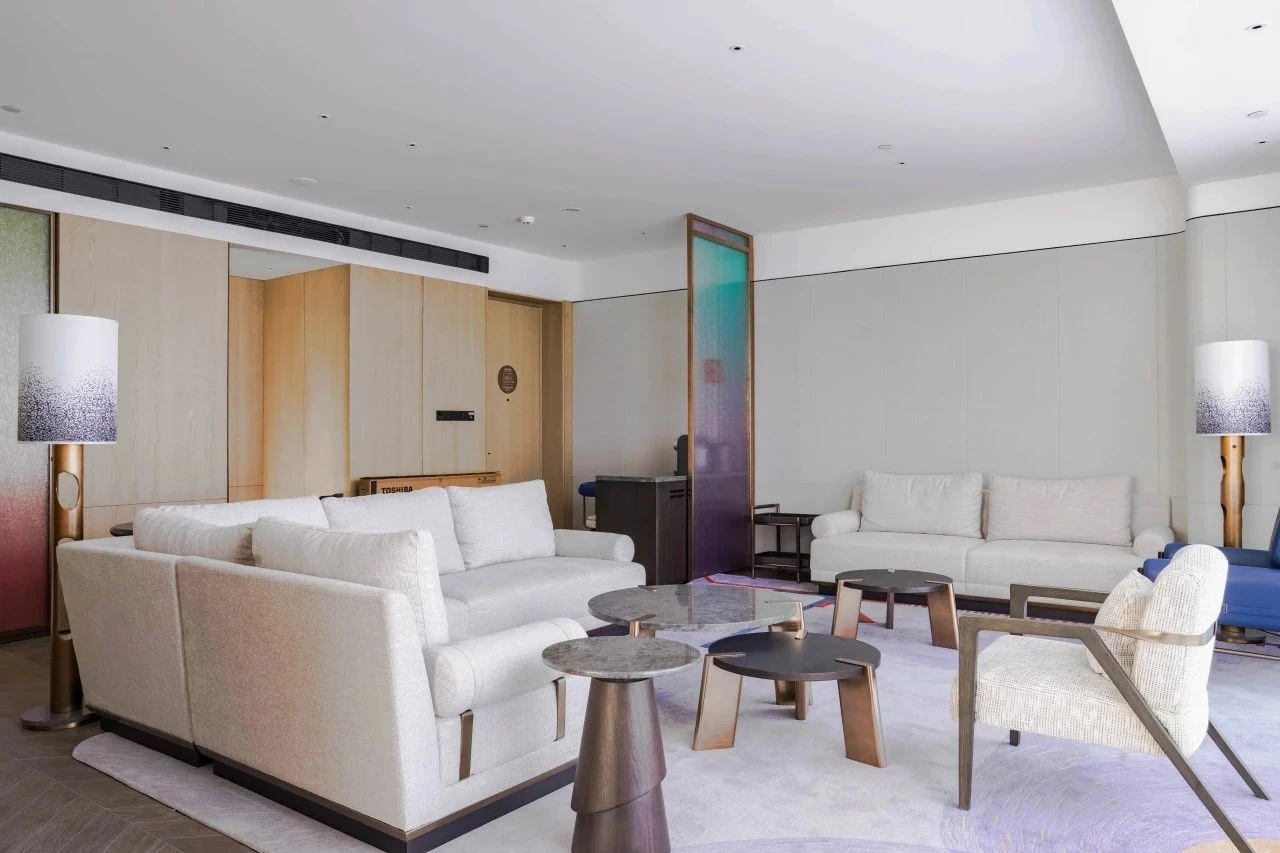
• Integration of fixed furniture and movable furniture: Fixed furniture (such as wardrobes, background walls, mini bars) should seamlessly connect with the wall and floor materials, and be equipped with maintenance access points and heat dissipation holes; movable furniture (beds, sofas, coffee tables) should form a style harmony with the fixed furniture. For example, the wood grain direction of the bedside table should be consistent with that of the wardrobe, and the fabric color of the sofa should form a gradient with the curtains.
• Pre-installation of intelligent modules: In response to the trend of smart hotels, when purchasing, it is necessary to plan the intelligent interfaces in advance. For instance, bedside tables should have positions reserved for wireless charging modules, desks should integrate hidden sockets and data panels, and wardrobes should have circuits reserved for sensor light strips. Some suppliers can provide an integrated solution of "furniture + intelligent modules", avoiding damage to the furniture structure during later renovations.
• Durability and maintenance costs: Suite furniture is used frequently, so priority should be given to choosing materials that are easy to clean and resistant to aging. For example, the tabletop can use granite or melamine decorative panels (resistant to scratches and penetration), and sofa fabrics are recommended to choose technology fabrics or water-resistant upholstery to avoid using woolen fabrics or difficult-to-clean leathers. At the same time, it is required that suppliers provide separate procurement channels for easily damaged parts (such as sofa legs, drawer slides), to reduce long-term maintenance costs.
Contract and Delivery: From "Verbal Promise" to "Legal Guarantee"
The procurement contract is a crucial tool for risk avoidance. Key points to be clearly stated in the terms include:
• Quantitative quality standards: Avoid using vague expressions like "high-quality" or "premium grade". The materials, craftsmanship, dimensions, and environmental protection levels should be included in the contract attachments. For example, "The drawer slides of the bedside table must use Blum or a similar brand, with a maximum opening and closing frequency of 50,000 times" and "The thickness of the desktop paint coating should be ≥ 0.3mm and the hardness should be ≥ 2H".
• Delivery milestones and breach of contract liability: Clearly define the time nodes for production, shipment, installation, and acceptance, and set up a penalty for delayed delivery (such as deducting 0.5% of the total contract amount per day). For customized products like suites, it is necessary to stipulate the "sample confirmation" stage - the supplier must first provide a 1:1 physical sample, which can only be mass-produced after being signed and confirmed by the hotel party, to avoid discrepancies between the bulk goods and the samples.
• After-sales and warranty clauses: Require the supplier to provide at least 3 years of free warranty (including hardware and structural components), and clearly specify the response time for after-sales services (such as on-site repair within 24 hours). For smart furniture in suites, it is necessary to additionally stipulate the responsibility division for software upgrades and hardware repairs to avoid disputes later.

Acceptance and Maintenance: From "One-time Delivery" to "Long-term Management"
After the furniture is delivered, a joint inspection by multiple departments is required:
• Sensory inspection: Check for no scratches, color differences, or bumps on the surface, uniform gaps at the joints (≤1mm), and smooth opening and closing of the hardware without any abnormal sounds.
• Function inspection: Test the drawer load-bearing capacity (≥30kg), the stability of the tabletop (no shaking when pressed), the sensitivity of the intelligent module, and whether the sealing between the furniture and the wall or floor is tight.
• Eco-friendly inspection: After installation, a third-party institution is commissioned to conduct indoor air quality testing to ensure that the indicators such as formaldehyde and TVOC meet the standards, and only then can the guest rooms be opened.
During daily operation and maintenance, a furniture file should be established to record the purchase date, warranty period, and repair history of each piece of furniture, and a regular maintenance plan should be formulated (such as waxing the solid wood furniture every quarter and checking the looseness of the sofa frame every year). For frequently used suites, 5%-10% of easily damaged parts can be reserved as spares to ensure that they can be quickly replaced in case of sudden damage, without affecting the rental of guest rooms.

Conclusion
The procurement of furniture for hotel suites is essentially a "investment in spatial value". It requires the purchaser to possess both aesthetic sensitivity and engineering rigor; they must not only control short-term costs but also accurately calculate long-term expenses. Through precise demand positioning, strict supplier screening, systematic product selection, rigorous contract management, and a scientific operation and maintenance system, it is possible to create suite furniture that not only conforms to the brand's style but also withstands the test of time. Each piece of furniture can become an "invisible language" for the hotel and its guests to communicate.


